How to make a website when you are the product
Creators are told they do not need a website because they have a following. Then a platform changes its algorithm, or its owner, and everybody who took that advice finds out what renting an audience means.
The advice that a creator does not need a website was true for about four years, and it stopped being true the first time a platform changed its rules overnight.
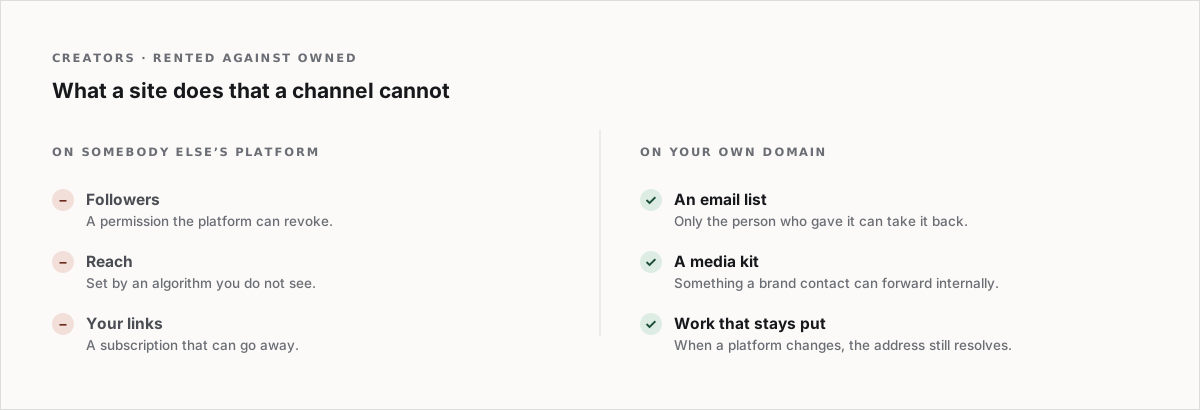
A website does three things your channels cannot: it collects an email list that belongs to you, it presents you to brands in a form they can forward internally, and it stays where it is when a platform does not.
The email list is the whole argument
Everything else on this page is secondary. A follower is a permission that a company can revoke. An email address is a permission that only the person who gave it can revoke.
So the signup needs to be the most prominent thing on the site, and it needs a reason attached. "Subscribe" is not a reason. "The one email a month about what actually worked" is.
And say what it is not: how often, and that you will not sell the list. Both increase signups measurably.
A media kit brands can actually use
The person who wants to work with you usually cannot approve it alone. They have to forward something to somebody else. Make that easy.
A good media kit page has:
- Who your audience is — not just how many. Where they are, roughly how old, what they are into.
- Real numbers, with the date on them. Reach, engagement rate, typical views. Stale numbers get caught and end conversations.
- What you have done before — two or three brand collaborations with what the deliverable was.
- What you will and will not do. Categories you avoid, and whether you do paid posts, affiliate, or both.
- How to start. An email address, not a form.
Price is the hard call. Publishing rates loses you the deals that would have gone higher; hiding them wastes your time on people who could never afford you. A "from" figure is usually the right compromise.
Links, but on your own domain
The link-in-bio services are fine until they are a subscription, or they go away, or they load slowly on a bad connection.
The same page on your own domain is faster, free, yours, and it can be a real page rather than a list of buttons — with your best work on it rather than only its addresses.
Show the work, not the follower count
A number ages badly and invites comparison. Three pieces of your actual best work, embedded and playable, ages well and is the thing anybody deciding about you actually wants.
Lead with the work. Put the numbers on the media kit page where they belong.
What to skip
An "as seen in" row of logos from one mention each. A long biography — nobody reads it, and the two sentences that matter belong at the top. Autoplaying anything.
Building it
Four things: a homepage that is your best work plus the email signup, a media kit page, a links page, and a contact address. That is a Saturday.
The thing to get right is not the design. It is that the email list exists before you need it.

Newsletter blocks, work grids and link rows. The sections a personal site needs, built to be edited in an afternoon. Browse the Market.