How to make a website for a heat pump installer
Heat pump buyers arrive sceptical, half-informed and worried about three specific things: whether it will actually heat the house, what it costs after the grant, and whether you will disappear afterwards. Answer those and the survey books itself.
Almost nobody arrives at a heat pump installer's website neutral. They have read a newspaper column saying these things do not work in cold weather, a forum thread saying the running costs are brutal, and a government page about a grant they half understood.
Your site is not introducing the product. It is settling an argument they are already having with themselves.
Meet the scepticism directly
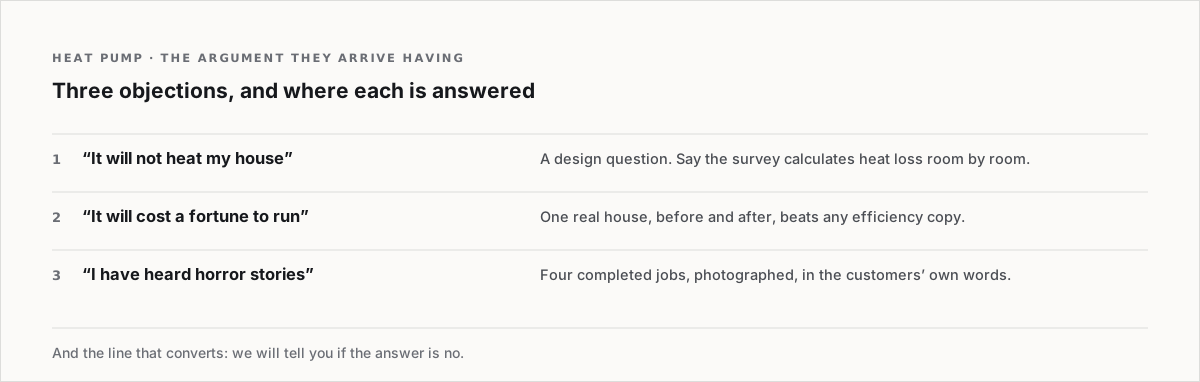
The three objections, and the only answers that work:
"It won't heat my house properly." This is a design question, not a technology question, and saying so is the most credible thing on your site. Explain that the survey calculates heat loss room by room, that the answer sometimes is that the house needs work first, and that you will say so.
"It'll cost a fortune to run." Give a real comparison for a real house you have done — the type, the insulation, before and after. One honest example beats any amount of efficiency copy.
"I've heard horror stories." You cannot argue with this. You can show four completed jobs with photographs and the customers' own words.
Be the clearest page about the grant
Whatever scheme runs in your country, most people searching have a vague idea it exists and no idea whether they qualify.
A page that states, in plain words, who is eligible, what it is worth, what it does not cover and how it is applied for will be found and shared. Keep it factual and dated — schemes change, and a page with a "checked on" date is one you can maintain rather than quietly leave wrong.
Say what the survey actually is
Buyers do not know whether a survey is a salesman with a clipboard or an engineer with a calculation. Say which:
- How long it takes.
- That it produces a room-by-room heat loss calculation.
- Whether it costs anything, and whether that is deducted if they proceed.
- That you will tell them if the answer is no.
That last line converts more than any other sentence on a heat pump site. The whole category is distrusted because of installers who never said no.
Accreditation, by name and number
Most grant schemes require a certified installer. Put the certification name and number where it can be checked, near the top. People will look it up. Making that easy is free credibility.
Show the untidy parts
A finished outdoor unit photographs well. The pipework, the cylinder cupboard, the radiators you had to change — those are what somebody is actually worried about. Show them. Nobody believes a heat pump installation that only has one photograph.
What the pages should be
- The homepage answering the three objections.
- A grant page kept current.
- A "is my house suitable" page with the honest version of the answer.
- Four case studies, each with house type, what was done, and a running-cost comparison.
- A survey booking form that asks for the house type and current heating.
What to skip
A diagram of the refrigeration cycle. Polar bears. The phrase "green future" — your buyer is doing this for the bill, the boiler that is about to die, or the grant, and dressing it as idealism reads as a dodge on the numbers.

The sections a service site runs on. Booking forms, coverage areas, pricing blocks and proof rows, sorted by the job they do. Much of the shelf is free. Browse the Market.