How to make a website for a padel club
Padel clubs are opening faster than anybody can build websites for them, and most of the sites are a booking link with a logo above it. Here is what the other 90 per cent of the page should do — especially for the people who have never played.
Padel has a specific problem that tennis does not: a large share of the people searching for a club near them have never played, do not own a racket, and have nobody to play with.
A website that is only a booking button serves the members you already have and turns away the people who would become new ones.
Build two routes, not one
The homepage has two audiences arriving in roughly equal numbers.
People who play. They want availability, prices, and the booking system, in that order, with as few clicks as possible. Make this a straight line.
People who have never played. They want to know whether they will embarrass themselves, whether they need equipment, and whether there is a way in that does not involve organising three friends.
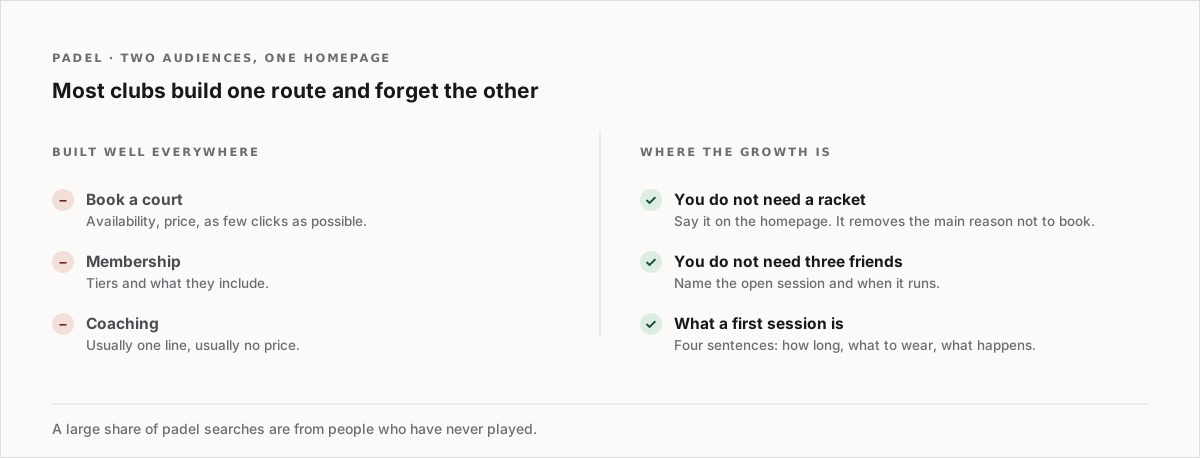
Most club sites build the first route well and forget the second entirely. The second one is where the growth is.
What the beginner route has to say
- You do not need a racket. If you loan them, say so on the homepage. It removes the single biggest reason somebody does not book.
- You do not need three friends. Name the thing you run for this — an open session, a mix-in night, a beginners' night — and say when it is.
- What a first session looks like, in four sentences. How long, what to wear, what happens when you arrive.
- What it costs, for one person, the first time.
A short video of a beginners' session does more here than any copy, because the unspoken question is "will everybody there be better than me".
Availability is the homepage, really
For the people who already play, the site is a means to a court. If your booking system has an embeddable view, put it high. If it does not, link straight to it from the first screen and do not make the button say "Members" — say "Book a court".
Peak times are the useful truth to publish: if weekday evenings are full for two weeks, saying so sends people to the mornings rather than to another club.
The sections that earn their place
- Coaching — with the coach named, their level stated, and the price. Coaching is high margin and it is usually one line on a page.
- Leagues and ladders — the thing that converts a visitor into somebody who comes weekly.
- Membership versus pay and play — the comparison, with the break-even spelled out. "Membership pays for itself at three sessions a month" is the most useful sentence on the page.
- Where to park. Genuinely. Half of padel venues are on industrial estates and people cannot find the door.
The local search part
Most searches are "padel near me" or "padel + town". That means the page has to say the town in plain words, have an address a map can read, and list opening hours. A club whose website never names its own town competes for nothing.
What to skip
The history of padel. Nobody has ever booked a court because they read about Acapulco in 1969.
Building it
Six sections: what and where, book a court, never played before, coaching, leagues, membership. The beginner section is the one that pays for the site.

Timetables, class rows and membership tables. Sections built for places people book time at. Much of the shelf is free. Browse the Market.