How to make a website for a sauna and cold plunge studio
Recovery studios sell an experience most visitors have never had, to people who are quietly nervous about it. The website's job is not to sell the science — it is to make the first visit feel survivable and easy to book.
A contrast therapy studio has an unusual selling problem. The product is genuinely good and genuinely uncomfortable, most of your market has never tried it, and the internet is full of overblown claims that make careful people suspicious.
The website that works is the calm one.
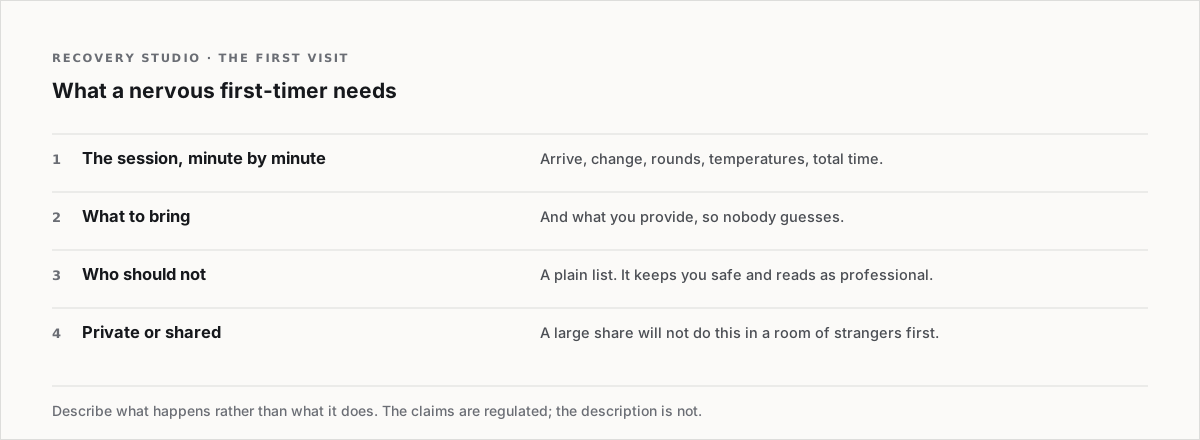
Describe the first session, minute by minute
This is the highest-converting thing you can put on the page, and almost nobody does it.
Something like: you arrive ten minutes early, you change here, you are shown how the timer works, fifteen minutes in the sauna, two minutes in the plunge at this temperature, repeat twice, shower, tea. Ninety minutes in total.
That paragraph answers about eleven anxieties at once — what to bring, whether you will be supervised, how cold is cold, whether you will be naked in front of strangers, and how long it takes.
Be careful with health claims, and be better for it
The category is full of confident statements about inflammation, metabolism and recovery. Some are supported, many are overstated, and in several countries a specific health claim on a commercial site is regulated.
The honest version is also the better copy. "Most people say they sleep better and feel clearer for the rest of the day" describes what your customers report. It does not need a citation and it will not get you a letter.
If you want to reference research, link the research and describe what it actually measured.
Say who should not do this
A short, plain list — pregnancy, heart conditions, certain medications, and a line saying check with a doctor — does three things. It keeps you safe, it signals that you know what you are running, and it converts the majority who read it and realise they are fine.
Studios that hide this look less professional, not more welcoming.
Pricing that matches how people buy
Three tiers, published:
- A single session, for the nervous first-timer.
- A pack of five or ten, which is how the habit forms.
- A membership, with the break-even stated in sessions per month.
And say whether you can book a private slot. A significant share of your market will not do this in a shared room the first time.
Photograph the heat, not the room
A wide shot of an empty sauna is a wooden box. What sells is the steam, the water, the wet floor, a towel, a person mid-exhale — the physical facts of the thing. Shoot it warm and low-light rather than bright and estate-agent.
The local part
Most of this is "sauna near me" and "cold plunge + town". Name the town in the copy, have a readable address, publish the hours, and say whether you take walk-ins. The last one matters more here than in most categories.
Building it
Five sections: what it is, what a first session involves, who should not, prices, and booking. Plus the safety list and the hours.

Session lists, price tiers and booking rows. The sections a studio needs, built to be edited rather than admired. Browse the Market.