How to make a website for a virtual assistant business
Virtual assistant websites nearly all say the same six words — organised, reliable, detail-oriented, proactive — which is how a whole category made itself interchangeable. The fix is narrower than you think.
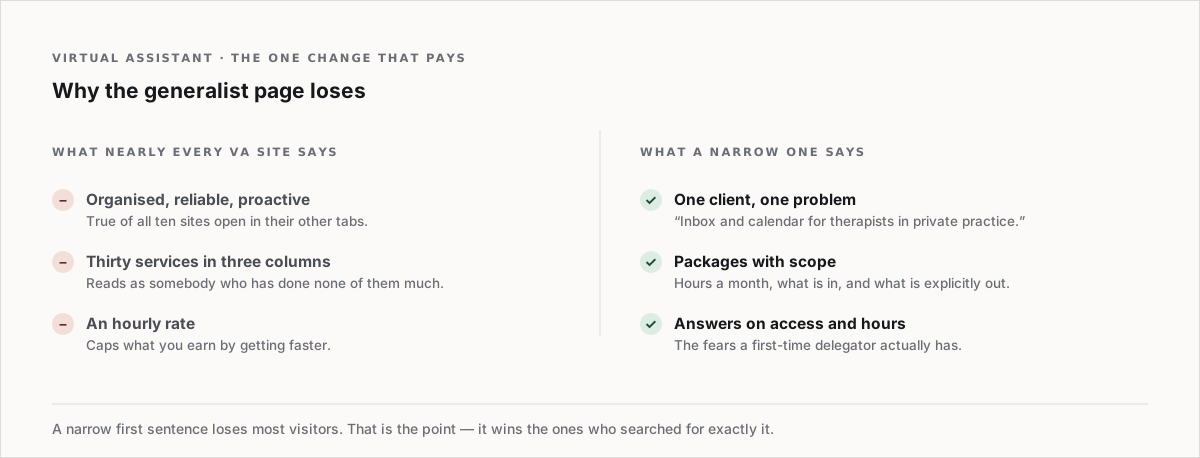
Open ten virtual assistant websites and you will find the same adjectives: organised, reliable, proactive, detail-oriented. Every one of them true, none of them a reason to choose you over the other nine.
The problem is not the writing. It is that the site is trying to be right for everybody.
Narrow it, and say the narrow thing first
The single highest-impact change on a VA website is putting a specific client and a specific problem in the first sentence.
"I do inbox and calendar for therapists in private practice." "I run the back office for two-person property firms." "Podcast production admin: show notes, scheduling guests, clips."
That sentence loses you most visitors, which is the point — it wins the ones who were looking for exactly it, and those convert at a completely different rate. A generalist competes on price with the entire internet. A specialist competes with two or three people.
Publish packages, not an hourly rate
An hourly rate invites clock-watching on both sides and caps what you can earn by getting faster.
Packages work better: a number of hours a month, what is included, what it costs. Three tiers is plenty. And name what is outside every tier, because scope creep is the thing that ends VA relationships.
If you genuinely cannot publish numbers, publish the range and what moves it.
Answer the questions a nervous first-time client has
Most people hiring a VA have never delegated before and are quietly worried about specific things:
- What hours are you actually available, in my timezone?
- How fast do you reply? State it. "Within four working hours" is a promise that wins work.
- How do we communicate? Email, a shared channel, a weekly call — say which, because some clients want a lot and some want none.
- What access will you need? This is the real fear. Explain how you handle passwords and what you will never ask for.
- What happens if you are ill, or on holiday?
- How do we stop? Notice period, plainly.
A page that answers those is doing the work of three emails and a call.
Show the tools, and the boundary
List the systems you work in. Clients search for them — a bookkeeper's VA who knows a specific accounting package is found by people searching that package.
And write the boundary down. You are not doing their tax return, or their legal filing, or being on call at weekends. Saying so is not defensive; it is the sign of somebody who has done this before.
Proof, when you cannot name clients
Most VA work is confidential, which makes testimonials hard. What works instead:
- An anonymised before and after. "A client was spending nine hours a week on scheduling. It is now under one."
- A quote with a first name and an industry.
- A short description of a typical week.
What to skip
Stock photographs of a woman in a headset. The word "solutions". A list of thirty services in three columns — it reads as somebody who will do anything, which reads as somebody who has done none of it much.

Package tables, FAQ rows and enquiry forms. The sections a service site runs on, sorted by the job they do. Much of the shelf is free. Browse the Market.