How to make a website for an EV charger installer
Almost nobody books an EV charger installation from the first page they land on. They are checking three things — can you certify it, can you do my kind of property, and what will it cost — and most installer sites answer none of them above the fold.
Somebody searching for an EV charger installer has usually just ordered a car. They have a delivery date, a driveway they are not sure about, and a vague worry that this will be complicated.
Your website has about fifteen seconds to replace that worry with a next step.
Answer the three questions above the fold
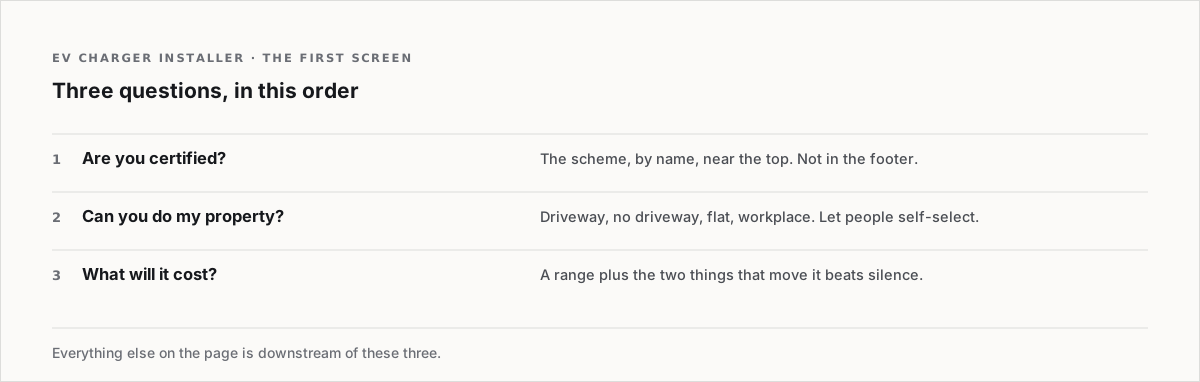
Every visitor is checking the same three things, in this order:
- Are you qualified to do this legally? Charger installation is notifiable electrical work. Say which scheme you are registered with, by name, near the top. Not in the footer.
- **Can you do my property?** A detached house with off-street parking is a different job from a first-floor flat with no allocated bay. Most people do not know which category they are in.
- What is this going to cost me? You cannot give a final price without seeing the consumer unit and the cable run. You can give a range, and a range beats silence.
A site that answers those three in the first screen converts better than a site with better photographs and none of them.
Property type is your real navigation
The most useful thing you can put on the page is not a services list. It is a short set of routes:
- House with a driveway — the straightforward one. Say so, and say how long it takes.
- House, no driveway — on-street charging, the council process, what is and is not possible. Being honest here wins the ones who can proceed and saves you the site visits that cannot.
- Flat or apartment block — landlord permission, shared supply, the parking bay question.
- Workplace or fleet — a different sale entirely, usually with a grant attached.
Let people self-select. They arrive knowing their property and not knowing your terminology.
Pricing without quoting
The two sentences that do the most work:
A standard installation on a house with off-street parking is normally between X and Y. What moves it outside that range is the distance from your consumer unit to the charger, and whether the board needs upgrading.
That is not a quote. It tells somebody whether to keep reading, and it explains the variable so a higher number later does not feel like a bait and switch.
The things people actually search for, on the page
If you install specific brands, name them. A large share of searches are brand-qualified — somebody has already chosen a charger and wants an installer who fits that one. A page that never mentions a brand does not match any of those searches.
Same for grants. If a funding scheme applies in your area, a page that explains the eligibility in plain words will be found by people searching the scheme rather than the service.
What the site needs after the homepage
- A survey booking form that asks for a photograph of the consumer unit. One question that saves a wasted visit.
- Two or three jobs with pictures — the cable run, the finished unit, the board. People want to see tidy work, not a stock photo of a car.
- A coverage area, stated as towns rather than a radius. Nobody knows if they are within twenty-five miles of you.
- Your certification number, somewhere it can be checked.
What to skip
The history of electric vehicles. The environmental case. Anybody on your site has already bought the car — the argument is won, and a page that re-argues it is a page that has not noticed who is reading.
Building it
This is a five-section site: the three answers, the property routes, the pricing range, the work, the booking. It is a weekend of writing and an afternoon of layout, in that order, because the writing is the hard part.

The sections a service site runs on. Booking forms, coverage areas, pricing blocks and proof rows, sorted by the job they do. Much of the shelf is free. Browse the Market.