Every AI model has a cutoff date. Your website inherits it.
One lab's small model knows nothing after February 2025. Its flagship knows to June 2026. Both will write you a page about your business with complete confidence, and only one of them knows what year it is.
A knowledge cutoff is the date after which a model has been taught nothing. It is not a bug and it is not hidden — every lab publishes theirs. It is just routinely forgotten the moment somebody asks a model to write something that will be published.
The dates, as published
From each lab's own documentation, 25 September 2026. We call the labs A, B and C and leave the model names out — the names change every few months; the pattern below has held for years.
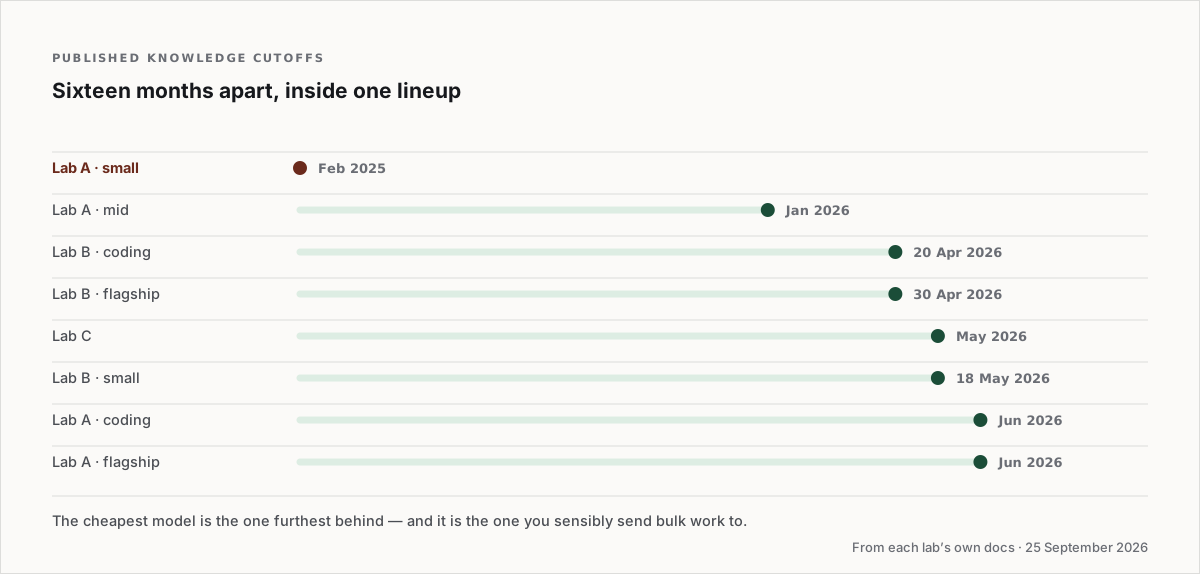
Lab A — flagship and coding tier: June 2026. Mid tier: January 2026. Small tier: February 2025.
Lab B — flagship: 30 April 2026. Coding tier: 20 April 2026. Small tier: 18 May 2026.
Lab C — its current model: May 2026.
Look at Lab A's row again. Within one lab's current lineup there is a sixteen-month spread, and the gap is widest exactly where you would not think to look: the cheap, fast model you sensibly route high-volume work to is the one furthest behind.
That is the trap. You do the right thing for your bill — send the bulk jobs to the cheapest model — and you have quietly sent them to the model with the oldest picture of the world.
What a cutoff does not stop
It does not stop the model answering. That is the whole problem.
Ask any model on that list what the current version of something is, what a company's pricing is, or who runs an organisation, and you will get a confident, well-written, specific answer describing the world as it was on the cutoff date. There is no hedge, because from the model's point of view nothing is uncertain.
Lab C states the consequence more plainly than most: its docs say its model has no knowledge of current events beyond its training data, and that real-time information requires enabling server-side search tools. That is true of every model in the list.
What this breaks on a website, specifically
Site copy is the worst place for this, because a website is read for years by people who assume somebody checked.
The things that go stale and still sound right:
- Prices. Yours, and anybody else's you mention.
- Anything with a version number. "Works with the latest…" ages badly and invisibly.
- Named people. Who runs a company, who to contact.
- Opening hours and addresses.
- Statistics and market claims. Especially a percentage with no year attached.
- "Leading", "newest", "first" — superlatives are a cutoff date wearing a disguise.
A model will write all of these fluently and none of them knowingly.
The rule we build to
DragGo's page builder writes copy for a business from whatever material that business gives us — a logo, a short brief, a few sentences. When the material is thin, the engine writes the rest rather than leaving template filler in place, because a page that still says the template's name reads as nothing having changed.
But there is a firewall around one category, and it does not move: facts are never invented. Prices, phone numbers, addresses, opening hours, people's names, reviews, statistics — these come only from the customer's own files. If the material does not contain a price, no price appears on the page. The model is allowed to write; it is not allowed to know things about your business that you did not tell it.
That distinction is the whole discipline. A model is excellent at expressing something and has no way of telling you whether it is currently true.

The firewall, in one line. Prices, phones, hours and names come only from your files. The model writes; it does not know. Try DragGo free.
What to check before you publish anything AI wrote
- Every number. Where did it come from? If the answer is "the model", delete it or verify it.
- Every proper noun that is not yours.
- Every superlative and every "latest".
- Anything with a date implied but not stated. "Recent research shows" — recent as of when?
- Your own details, which the model may have helpfully completed for you.
It takes about ten minutes on a five-page site and it is the difference between a site that reads as written by somebody who runs the business and one that reads as generated.
If you are picking a model for this kind of work, the cutoffs are one of four things worth comparing.