How to compare AI models: four things the labs publish
No benchmark scores, because we did not run them. This is the comparison you can verify yourself: price, context, knowledge cutoff and reasoning controls, read off the labs' own documentation — and what the numbers say when you line them up.
Most model comparisons lead with benchmark scores. We did not run any benchmarks, so there are none here.
What follows is the part anybody can check and almost nobody tabulates: what each lab publishes about its own models. Prices, context, cutoffs, and the controls you get. All of it read off the official docs on 25 September 2026. We call the three labs A, B and C and leave the model names out — they change every few months, and the method does not.
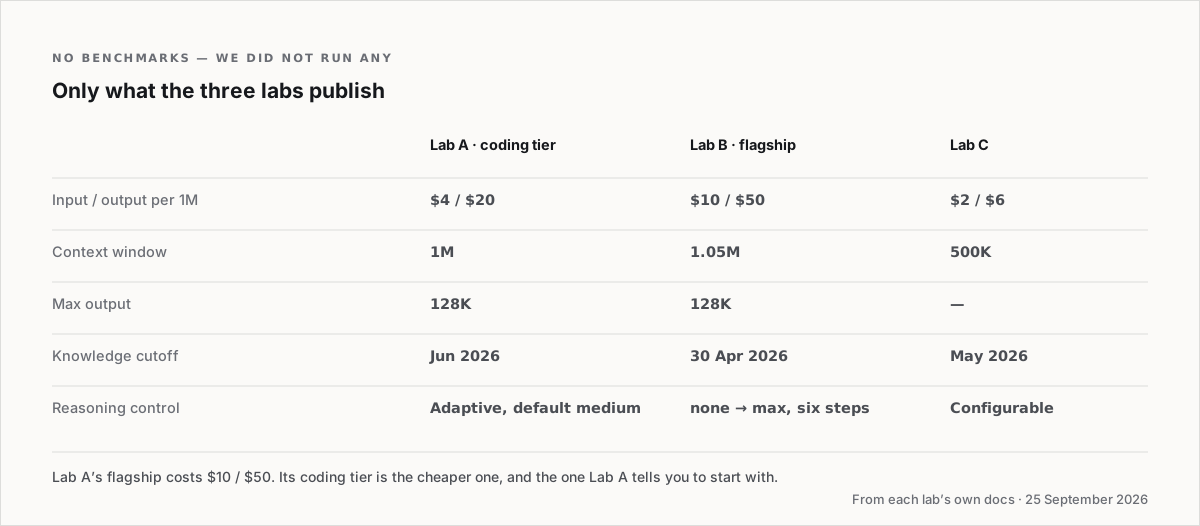
Price
Per million tokens, input / output:
- Lab A, coding tier — $4 / $20
- Lab A, flagship — $10 / $50
- Lab B, coding tier — $2 / $10
- Lab B, flagship — $10 / $50
- Lab C — $2 / $6
Two observations. Lab A's coding tier is the cheaper of its two top models and the one Lab A tells you to start with — its flagship is held back for demanding reasoning and long-horizon agentic work. And Lab C has the mildest output multiplier of the group: 3× its input price, where the others charge 5×.
That multiplier matters more than the headline. A summarising job reads a lot and writes a little. A generating job does the opposite. Work out which you are before you compare sticker prices.
Context window
- Lab A, flagship, coding and mid tiers — 1M tokens
- Lab B, every tier — 1.05M tokens
- Lab C — 500K tokens
- Lab A, small tier — 200K tokens
A million tokens is not a feature you use casually — you pay for every one you send. It is an upper bound for jobs that genuinely need a whole codebase or a long document in one go.
Max output is more often the real limit, and there the large models agree on 128K.
Knowledge cutoff
- Lab A, flagship and coding tier — June 2026
- Lab A, mid tier — January 2026
- Lab A, small tier — February 2025
- Lab B, flagship — 30 April 2026
- Lab B, coding tier — 20 April 2026
- Lab B, small tier — 18 May 2026
- Lab C — May 2026
Note how far apart these are within a single lab. Lab A's small model stops in February 2025, sixteen months behind its own flagship. If you route cheap work to a cheap model — which you should — you are also routing it to an older picture of the world. That has consequences for anything published.
Lab C is unusually direct about the implication. Its docs state that its model has no knowledge of current events beyond its training data, and that real-time information requires enabling server-side search tools. Every model in this list has that property. Not every lab writes it down so plainly.
Reasoning controls
This is where the three genuinely differ, and it is the setting with the largest effect on your bill.
Lab B exposes a reasoning level on every model: none, low, medium, high, xhigh, max. Six positions including off.
Lab A describes thinking on its flagship and coding tier as adaptive and always on, with a default effort — medium on the coding tier, high on the flagship. Its mid tier is adaptive; its small tier uses extended thinking.
Lab C describes reasoning as configurable. Its docs also note that logprobs and top_logprobs are silently ignored on its newer models, and that it always returns encrypted reasoning content on its Responses API.
"Silently ignored" is worth reading twice. A parameter that is accepted and then discarded is the kind of thing you discover from a bill rather than an error. Reasoning settings deserve their own page, and we gave them one.
Which one, then?
For building websites, a coding tier rather than a flagship — every lab here has one, and they sit in the same bracket on price. Lab A's own guidance is to reach for its flagship only when evaluations on the coding tier at higher effort fall short, and that is a good rule for any lab's top model.
The more useful decision is not which of these you pick. It is how many of your steps need a model at all.

We route by job, not by name. The plan gets a frontier model. Alt text does not. Same page, a fraction of the cost. Try DragGo free.
A note on dates
This page is a snapshot. Model lineups change monthly and prices change without much warning, so the specific numbers above carry a date rather than a claim to be current forever. If you are reading this long after September 2026, take the four questions and re-check the figures — each lab's own pricing and model pages are the only source worth trusting for this.