Can AI redesign a website you already have?
Most AI builders can only create a new site from a description — point them at the page you already own and there is nowhere to put it. Here is how a URL becomes a design brief, why your own site and a competitor's are read differently, and the rule that stops an AI inventing your prices.
"Redesign my website with AI" and "build me a website with AI" sound like the same request. They are not, and the difference is the single most common disappointment in this category.
Most AI builders create. You describe a business, they generate a new site. Point one at the page you already own — the one with your prices on it, your opening hours, the paragraph you finally got right — and there is often nowhere to put it. Wix's help centre states it plainly: their AI Website Builder creates new sites only.
So the honest answer to the question is: yes, AI can redesign an existing site, but only if the tool has somewhere for the existing site to go. This is how ours does it.
A URL becomes a brief, not a copy
When you say "our current site is example.com, rebuild it", the page is fetched and read the same way a screenshot of a design would be read: the palette, the mood, which sections exist, what each band is really about, how each one sits.
Then the engine composes its own page from that reading.
That is deliberately not a clone, and it is the right choice for the same reason a pixel-perfect Figma conversion is the wrong goal. A clone of a five-year-old site is a five-year-old site. What you want is the decisions carried forward — this is a shop, the brand is green, there are four services and a booking step — onto a layout that was measured this year.
The fetch itself is done by our server, on public hosts only, and no script from the page is ever run. It reads what a visitor would see.
Your own site and somebody else's are read differently
This is the part I would want to know before trusting a tool with a URL.
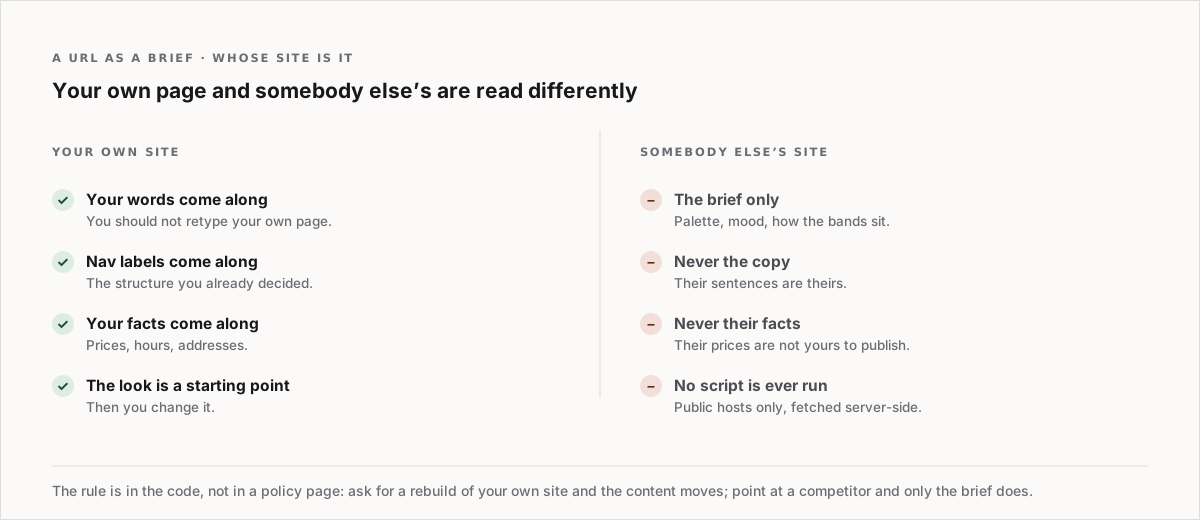
Ask for a rebuild of your own page — "our site", "my current site", "rebuild it and keep the content" — and the words come with it. Your headings, your nav labels, your facts. You should not have to retype your own website, and a tool that makes you is wasting the only part you cannot regenerate.
Point at somebody else's page — "a site like competitor.com" — and only the brief comes across. The palette, the mood, the shape. Never their sentences and never their facts, because their prices are not yours to publish and their copy is not yours to take.
That distinction is written into the code rather than into a policy page, which is the version I would look for in any tool. A tool that does not draw the line will happily hand you a competitor's paragraph with your logo on top, and you will not find out until they do.
The rule that matters more than the redesign
A redesign moves your facts. Which means the risk is not an ugly page — it is a confident wrong number. An AI that invents your opening hours is worse than no AI at all, because the mistake arrives looking finished.
So every fact is checked before you see it.
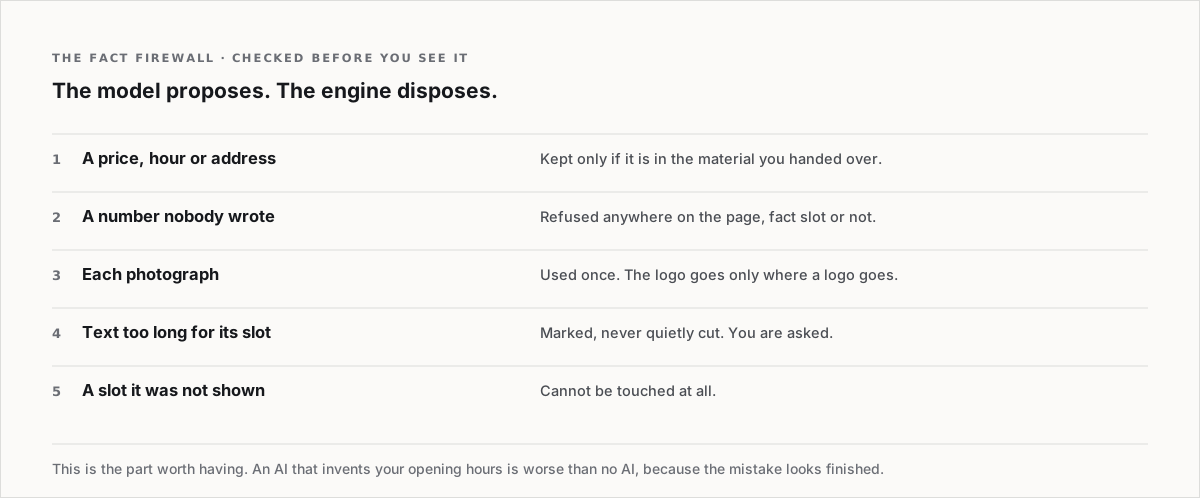
The model proposes; the engine disposes. A price, a phone number, an address, an hour, a quoted line: each one is kept only if it is actually in the material you handed over. A figure nobody wrote is refused anywhere on the page, whether it landed in a fact slot or in the middle of a sentence. Each photograph is used once. Your logo goes where a logo goes and nowhere else. And text that is too long for the space it landed in is marked, not quietly trimmed — you get asked.
It also cannot touch a slot it was never shown, which sounds like a small thing and is the reason a redesign cannot wander off into a section you were happy with.

Point it at your own page and keep your words. The look becomes a brief. Your copy, nav and facts move across intact. Browse the Market.
What a redesign does not fix
It will not fix your content. If the current page does not say what you do in the first line, a new layout makes that failure prettier and no clearer. The reading is a brief, not an editor.
It will not preserve your URLs either. That is a separate job and it is the one people skip: redirect the old addresses to the new ones before anybody notices they moved, or the redesign costs you the rankings the old site had earned.
And it will not make the decision for you about whether the old design was actually the problem. Quite often the old design was fine and the copy was the problem, which is cheaper to fix and less fun.
The useful thing to take from this
Before you let any AI tool near a site you already own, ask it two questions. Can it read the page I already have, or only a description of it? And what stops it publishing a number I never gave it?
The first tells you whether you are redesigning or starting again. The second tells you whether you will have to proofread every line before you trust it — and on a business site, that is the difference between a tool and a chore.