What it actually costs to build a website with AI
One big call to the best model is the obvious way to build a page with AI, and it is the expensive one. Splitting the same work across eight calls took our cost per page down by about sixty per cent with no change in what came out.
The cost of an AI feature is rarely decided by which model you chose. It is decided by how many tokens you generate, and by how much thinking you paid for on work that did not need any.
This is a breakdown from DragGo's own page builder, which writes real sites for real businesses rather than demos.
The obvious build, and what it cost
The first version asked one question: here is a business, write me a page. One call, the best model available, a large structured response with every section in it.
It worked. People got pages they liked. It was also slow enough that we put a progress animation on it, which is usually a sign you have accepted something you should have fixed.
And it was the expensive way. Every word on the page was paid for at frontier prices, including the words that did not need a frontier model — which, it turned out, was most of them.
The same work, split by job
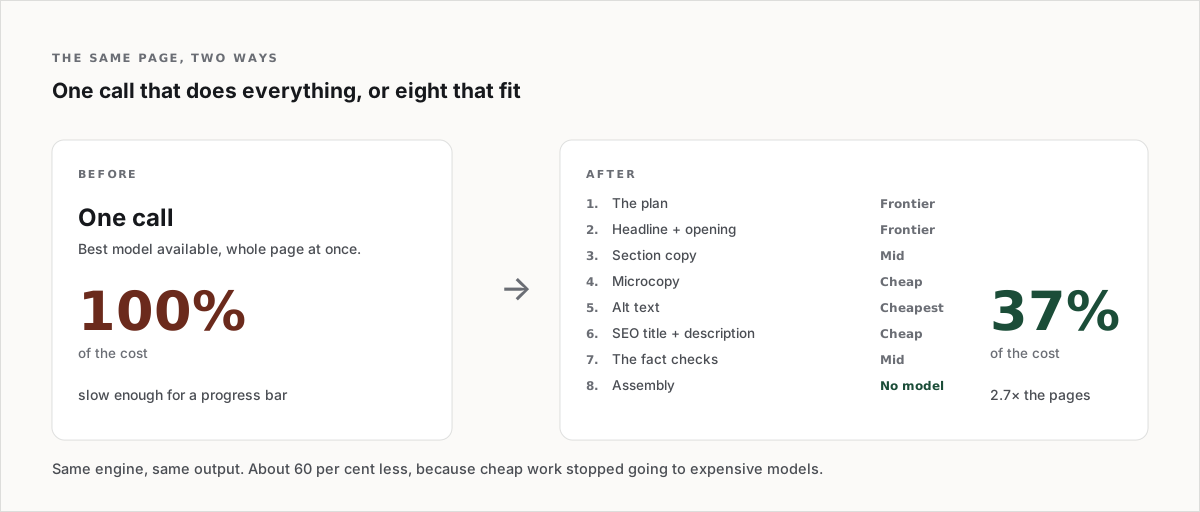
We broke that single call into eight, and sent each to a model chosen for what that step actually is:
- The plan — what this business is, what the page needs to contain, in what order. Genuinely hard. Frontier tier.
- The headline and opening — the words that decide whether anybody reads the rest. Frontier tier.
- Section copy — real writing, but against a brief that already exists. Mid tier.
- Microcopy — buttons, labels, form hints. Cheap tier.
- Alt text — a description of a picture. Cheapest tier available.
- SEO title and description — a fixed shape with a character limit. Cheap tier.
- The checks — does every claim in this page come from the customer's own material. Mid tier, and worth every token.
- Assembly — no model at all.
Result: about sixty per cent less per page, with no change in what came out the other end. On the same plan, that is nearly three times as many pages.
The three things that actually saved the money
Cheap work went to cheap models. Alt text for eleven images was, in the first version, being written by the same model that planned the page. One lab prices its small model at a hundredth of its flagship's input rate; another, at a quarter of its coding tier's. The difference in quality on "describe this photograph" is not measurable; the difference in price is two orders of magnitude.
Reasoning was set rather than defaulted. A model given no guidance about difficulty assumes difficulty. We watched that turn one step into a 170-second step.
Some steps stopped being model calls entirely. This is the one people skip. A lot of what gets sent to a language model is not a language problem:
- Deriving a palette from one brand colour is colour arithmetic.
- Checking a text colour against its background is a contrast formula.
- Choosing image dimensions is a calculation.
- Writing
lastmoddates into a sitemap is a git command.
All of those are free, instant, and more reliable in code than in a prompt. Every one of them was a model call once.
What this means if you are buying rather than building
If you are comparing AI website builders, the question worth asking is not which model is behind it. It is whether the thing has been engineered at all, and there are two tells you can check from the outside:
How long does a page take? A tool that takes two minutes for a five-section page is doing one enormous call. A tool that streams sections as they finish is doing several.
What happens to your credits on a small edit? Changing one heading should not cost what generating the page cost. If it does, the tool is regenerating everything, and you are paying for seven sections you did not ask to change.

See what that actually buys. Real pages for real businesses, with a fact firewall so nothing about you is invented. Try DragGo free.
The honest limits
The numbers here describe our pipeline, on our plans, in September 2026, and they do not translate directly to anybody else's pricing.
What does transfer is the ratio. Splitting a monolithic generation call by job, matching the tier to the task, and deleting the steps that were never language problems is worth somewhere around half your cost, at any lab, at any model generation. The models in that pipeline have been replaced twice since we made the change. The change still holds.