The best AI model for building websites is not one model
Every major AI lab now sells a model good enough to build a page. Picking one for the whole job is what makes it slow and expensive. Here is how the work actually splits.
Every few weeks the answer to "which AI model should I use" changes, and every few weeks somebody rewrites the same league table. The table is not wrong. It is just answering a question that does not decide anything.
Building a web page is not one task. It is a plan, some words, a layout, a palette, a set of alt texts, and a check at the end. Those have wildly different difficulty, and paying frontier prices for all of them is how an AI feature ends up costing more than it earns.
Where the lineups stand today
Checked against each lab's own documentation on 25 September 2026. Prices are per million tokens, input / output. We leave the model names out on purpose: they change every few months, and nothing below depends on which one you pick.
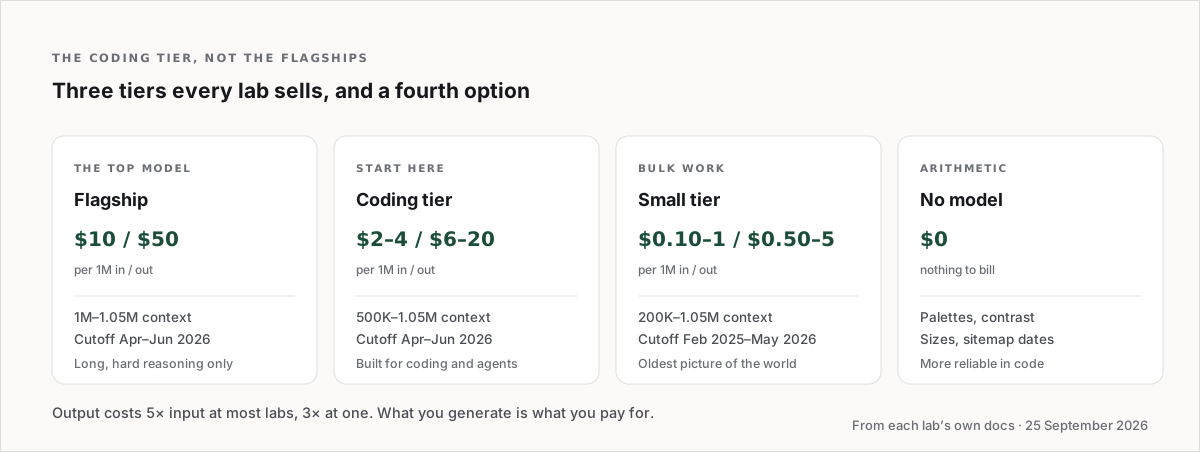
Every major lab now sells the same shape of lineup:
- A flagship at about $10 in / $50 out, with a context window of a million tokens or a little more. The labs position it for long, demanding reasoning — not as the default.
- A coding tier between $2 and $4 in and $6 and $20 out, with 500K to just over a million tokens of context. This is the tier the labs describe as built for coding and agentic work, and the one at least one of them tells you to start with.
- A small tier from $0.10 to $1 in and $0.50 to $5 out. Fast, cheap, and often the furthest behind on what it knows — more on that here.
Two things jump out of that list. The cheap models are not cheap-and-nasty any more — one lab's small model is a hundredth of its flagship's input price on the same context window. And output costs five times input at most of these labs, and three times at the other. What you generate is what you pay for.
The part the league tables miss
We measured this on DragGo's own page builder, which writes real sites rather than demos.
The first version did what everybody does: one enormous call to the best model available, asking for the whole page at once. It worked. It was also slow, and most of what it was thinking hard about did not need thinking about.
Splitting that single call into eight, and sending each one to the model its job actually needs, cut the cost of a page by about 60 per cent. Same engine, same output quality. For somebody on a plan, that is nearly three times as many pages for the same money.
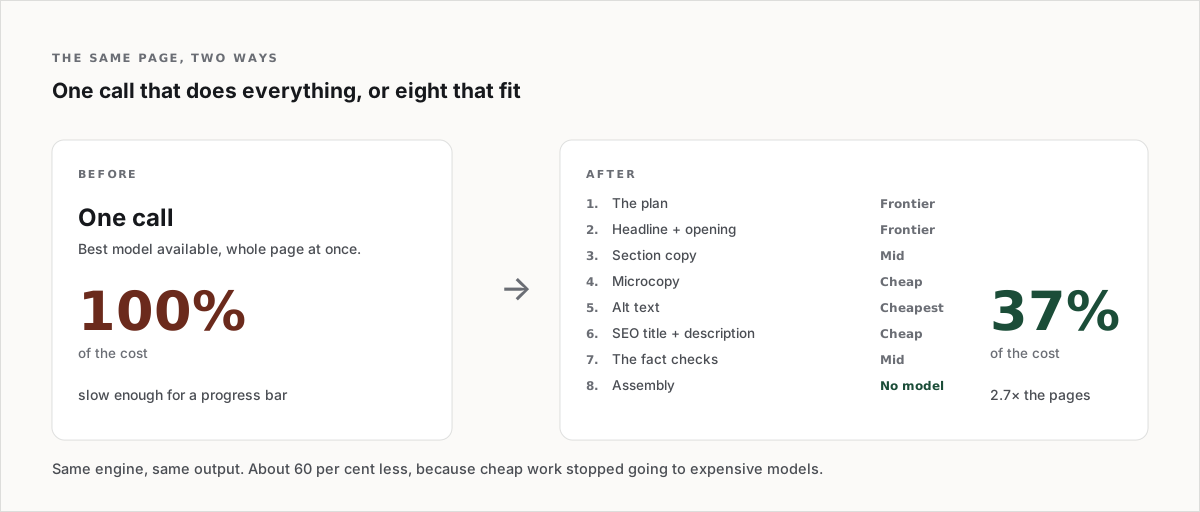
The split is not clever. It is just honest about difficulty:
- Deciding what the page should contain — the plan, the order of the sections, what the business actually does. This is the hard one. Frontier model.
- Writing the headline and the opening paragraph. Also hard, in a different way. Frontier model.
- Body copy for a section you have already planned. Mid-tier.
- Alt text for eleven images. Cheapest model you have. It is a description of a picture.
- Picking a palette from a brand colour. Not a model job at all — that is arithmetic, and we do it in code.
That last line is the one worth stealing. A surprising amount of what people send to a model is not a language problem. Contrast ratios, spacing scales, image sizing, sitemap dates — all of it is deterministic, all of it is free, and all of it is more reliable in code than in a prompt.
So what should you actually use?
If you want one answer and you are building websites: start with a lab's coding tier rather than its flagship. Every major lab has one, each costs a fraction of its flagship, and each is described by its own maker as the one for agentic coding work.
Move up when you can show your evaluations failing, not because the bigger number feels safer.
And if you are building a product on top of these rather than using a chat window, the sentence that saves the most money is not about which model. It is: does this step need a model at all?

A page builder that splits the work. Eight calls, each on the tier its job actually needs, instead of one expensive one. Try DragGo free.
The honest caveat
Every number above is from a lab's own documentation on one day in September 2026, and this is the fastest-moving list on the internet. Treat the shape of the argument as durable and the prices as a snapshot — the split-by-job point survives every one of these models being replaced.
DragGo's own agent works this way because we measured it rather than assumed it. The full cost breakdown is here.